Talk to our sales team
+55 11 5189-4120
Events
Off-site corporate training: how to organize the logistics
How to organize off-site corporate training: choosing the venue, group transportation, accommodation, meals, the agenda and participant registration.
 5 min read
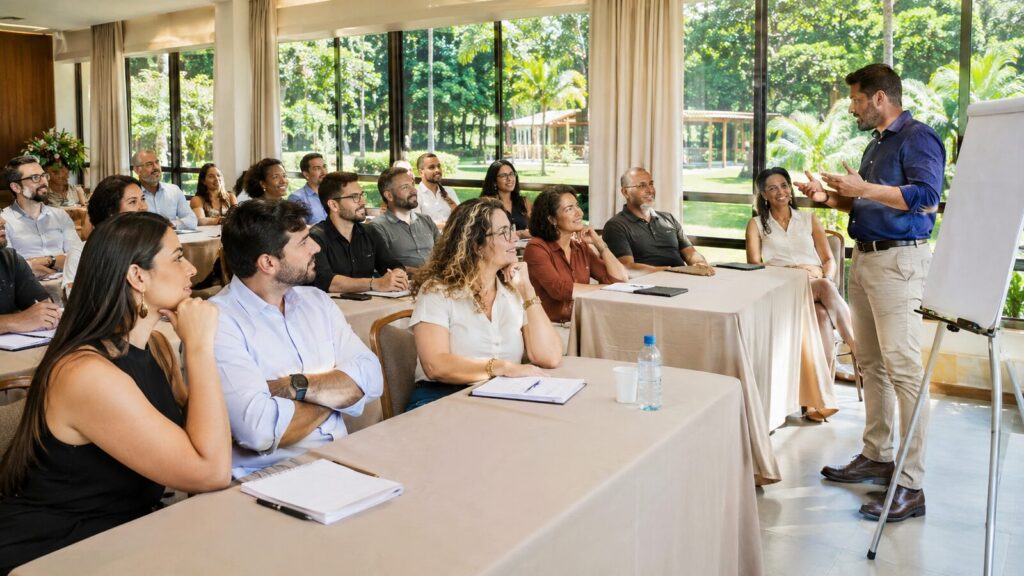
Taking a training program off-site changes the outcome. Away from day-to-day meetings, messages and desk interruptions, participants pay more attention, share more experiences and absorb the content better. On the other hand, an off-site corporate training session requires logistics that the office meeting room does not: transportation, accommodation, meals, equipped rooms and an agenda that works from start to finish.
Since 1989, ArrowTur has been organizing corporate travel and events, including training for sales, technical and leadership teams at hotels and convention centers. This guide covers what needs to be planned so the training runs without improvisation and with full focus on learning.
Define the format before choosing the venue
The right venue depends on the type of training. Before asking for quotes, answer a few questions:
- How many people will attend and whether they come from one city or from several regions.
- How many days the training lasts and whether there will be overnight stays.
- What the session format is: talks for the whole group, small-group work, hands-on activities or a mix.
- What equipment is needed: projector, screens, reliable internet for everyone, microphones, flip charts, room for standing activities.
- What the budget per participant is, including travel, accommodation and meals.
With these answers, it is easier to compare proposals and avoid picking an attractive hotel that cannot accommodate the training format.
Hotel, resort or training center
Each option has its advantages. Hotels in cities with good air access make it easier for participants from different regions to get there and usually have modular rooms. Countryside hotels and resorts, a few hours away by car or coach, help people disconnect and work well for groups leaving from the same city. Training and convention centers have technical facilities ready to go but require separate accommodation if the program runs for more than one day.
When visiting or assessing the venue, check the natural light in the rooms, the soundproofing, the internet speed with the whole group connected, the distance between meeting rooms, restaurant and guest rooms, and whether extra breakout rooms are available.
Group transportation
When participants come from different cities, flights should be booked early and, if possible, as a group block, to secure fares and schedules that fit the agenda. Ideally, everyone arrives in time for the opening, and return flights do not force anyone to leave in the middle of the last session.
For groups leaving from the same city, chartered coaches or vans are usually the most practical and economical choice, and they turn the journey into a team-building moment. In both cases, arrange transfers from the airport or the meeting point to the venue, with set times and someone in charge of welcoming the group.
Accommodation and meals
For training with overnight stays, accommodation should be arranged with the hotel through a room block, with a deadline for sending the rooming list and clear cancellation rules. Decide in advance whether rooms will be single or double and how special requests will be handled.
Meals are also part of the learning experience. Heavy lunches drain afternoon attention, while well-spaced coffee breaks help keep energy up. Let the hotel know in advance about participants’ dietary restrictions, collected at registration.
An agenda that respects the group’s pace
A good off-site training program alternates content, practice and rest. Some practices help:
- Sessions of no more than 90 minutes, with breaks in between.
- Hands-on activities right after lunch, when attention usually dips.
- An evening networking moment, kept moderate, for those staying overnight.
- Enough free time for participants to handle urgent work matters without missing sessions.
- A closing session reviewing the content and next steps, before the transfers leave.
Registration, communication and follow-up
Centralize registration in a single form, collecting details for flights, accommodation, dietary restrictions and accessibility needs. Send participants a guide with the agenda, transportation times, contacts and what to bring. During the event, someone from the organizing team should be available to handle surprises such as flight delays and room changes.
After the training, a short participant survey helps measure satisfaction with the content and the logistics, and guides the planning of future sessions.
Off-site corporate training with ArrowTur
ArrowTur handles the full logistics of off-site training: sourcing and negotiating hotels and meeting rooms, room blocks, group air tickets, chartered coaches and transfers, registration management and participant support before and during the event. Our team is available Monday to Friday, 7 a.m. to 7 p.m. (Brasília time), with emergency support outside those hours. Learn about our corporate events services and request a proposal.
To talk to our sales team, call +55 11 5189-4120 or message us on WhatsApp.
Read also: Corporate event venue: how to choose without surprises.
Frequently asked questions
How far in advance should I plan an off-site training?
For medium and large groups, ideally start at least three months ahead, especially in high season, to secure meeting rooms, guest rooms and flights on good terms.
Is it better to hold the training at a hotel in the city or outside it?
It depends on the goal. Outside the city, the group disconnects more from the routine; in the city, costs and travel time are usually lower.
Who should handle participants’ flights and accommodation?
Ideally, centralize everything with a single provider, such as an agency, to negotiate group rates, manage names and deadlines and support participants when something changes.