Talk to our sales team
+55 11 5189-4120
Events
Team building: activities that work and how to plan them
Team building that works: how to set the goal, choose the right activity format, handle logistics and safety, and measure the results with your team.
 5 min read
Team building has become a catch-all term: any group activity outside the office gets the label. As a result, many companies invest in a day of activities, the team has fun, and the following week nothing has changed in the way people work. The problem is rarely the activity itself, but the lack of a clear goal behind it.
ArrowTur has been organizing corporate events since 1989, from small team gatherings to conventions with hundreds of people. In this article, we cover what separates team building that works from an expensive outing: how to set the goal, which formats suit each situation and which logistics precautions prevent problems on the day.
Start with the goal, not the activity
Before choosing between a hike, a cooking workshop or a team challenge, answer one question: what needs to change after the event? The most common answers are:
- Integration: a new team, merged departments or many remote employees who barely know each other.
- Cross-department collaboration: sales and operations, or headquarters and branches, that need to work better together.
- Communication and trust: teams with conflicts or difficulty giving and receiving feedback.
- Recognition: celebrating a result and strengthening the bond with the company.
Once the goal is clear, it is easier to choose the format, the duration and how to measure whether it was worth it.
Formats that tend to work
Team challenges
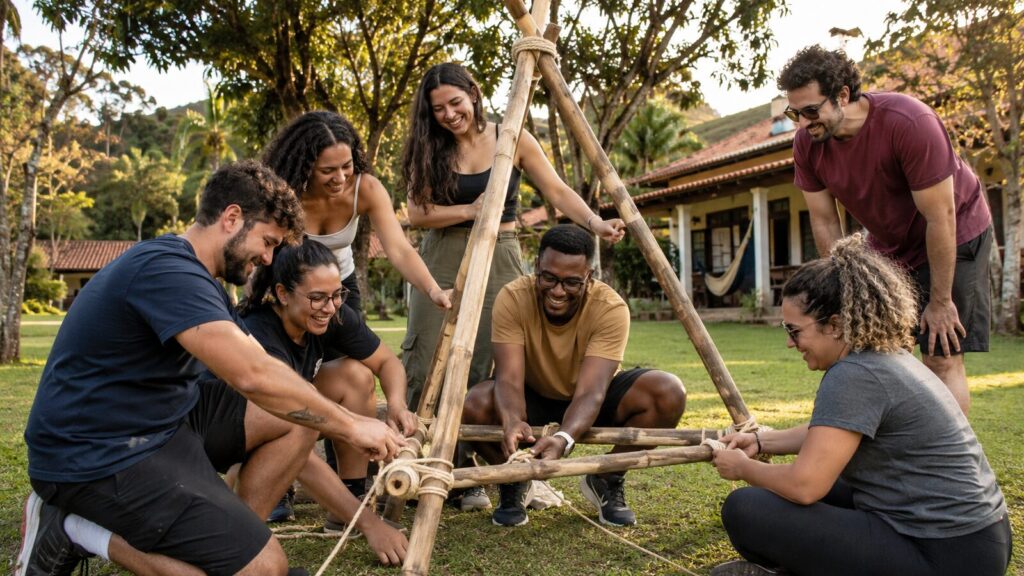
Activities in which small groups solve a problem with limited time and resources, such as building a structure, completing a treasure hunt or assembling a product. They work well for collaboration, role sharing and decision-making. The key is the debrief afterwards, led by a facilitator, linking what happened to everyday work.
Outdoor activities
Easy trails, circuits, adapted sports and team games at country hotels or resorts take the team out of its routine and encourage integration. They should be chosen with everyone in mind: not everyone has the same fitness level, and the activity must not leave anyone out.
Creative and cooking workshops
Cooking together, creating a group piece or joining a music workshop require coordination and communication without the pressure of competition. They are good options for diverse groups and for those who prefer indoor activities.
Social impact activities
Putting together kits for a charity, refurbishing a community space or joining an environmental project unites the team around a purpose. They require planning with the partner organization and care to make sure the action is genuinely useful.
Part of an event or a day of its own
Team building can be a standalone event or part of something bigger, such as a sales convention, an annual kick-off or a managers’ meeting. Some guidelines:
- within an event, set aside a two- to four-hour block, preferably on the first day, so that the integration carries over into the rest of the program;
- as a standalone event, a full day or a weekend at a venue outside the city allows for more complete activities and free time together;
- avoid placing the activity at the end of a long day of meetings, when the group is already tired.
Logistics and safety
Much of a team building’s success depends on what happens before the activity starts. Points that deserve attention:
- Suitable venue: enough space for the group, a covered area as a plan B in case of rain, and support facilities such as restrooms, water and shade.
- Experienced supplier: companies specializing in corporate activities bring facilitators, equipment and tested programs. Ask for references and confirm insurance for adventure activities.
- Inclusion: ask in advance about physical, dietary and accessibility needs, and offer alternatives for anyone who cannot take part in a given stage.
- Transportation and timing: travel to the venue must be organized, with generous schedules so the activity does not start late.
- Voluntary participation: activities that embarrass or expose people have the opposite effect of what you want.
How to know if it worked
Measuring team building does not need to be complicated. Right after the event, a short survey shows how participants felt. A few weeks later, look for practical signs tied to the original goal: more conversation between departments, joint projects, fewer communication breakdowns. Revisiting the lessons from the activity in a meeting helps keep the effect going.
Team building with ArrowTur
ArrowTur handles all the logistics of your team building: we help choose the venue, get quotes from hotels and event spaces, organize the group’s flights and transfers, manage rooms and participants and work together with the activity suppliers. Our team supports the operation Monday to Friday, 7 a.m. to 7 p.m. (Brasília time), with an emergency on-call service outside those hours. Learn more about our corporate events services.
To talk to our sales team, call +55 11 5189-4120 or message us on WhatsApp.
Read also: Managers’ meeting: how to plan it from goal to logistics.
Frequently asked questions
How long should team building last?
It depends on the goal. Within an event, two to four hours is usually enough. As a standalone event, a full day or a weekend allows for more complete activities.
What is the best team building activity?
The one that matches the goal and the group’s profile. Team challenges build collaboration; workshops and social impact activities work well for diverse groups.
How far in advance should I plan?
For groups that travel or stay outside the city, start at least two to three months ahead to secure the venue, rooms and flights on good terms.