Talk to our sales team
+55 11 5189-4120
Events
Strategic offsite: how to take leadership out of the office
Goal, agenda, facilitation and logistics: how to plan a strategic offsite that takes leadership out of the routine and ends with clear decisions and actions.
 5 min read
Day to day, a company’s leadership spends most of its time handling what is urgent. Back-to-back meetings, messages to answer and operational decisions leave little room to discuss what really shapes the future of the business: priorities, targets, structure and the next steps of the strategy. A strategic offsite exists precisely to create that room, taking the leadership out of the office for one or more days.
ArrowTur has organized corporate gatherings since 1989 and has seen up close what makes an offsite work. The venue matters, but it is not the main factor. What defines the outcome is a clear goal, a well-built agenda, good facilitation and logistics that run smoothly without anyone having to think about them.
What a strategic offsite is and when to hold one
A strategic offsite is a leadership meeting held away from the workplace, focused on discussing and deciding long-term issues. Unlike a convention or a team-building event, it usually brings together a small group of directors and managers, and its deliverable is concrete decisions and an action plan.
The most common moments for an offsite are planning for the following year, a mid-year strategy review, the arrival of a new leader, a merger or acquisition, or a major shift in the market. Many companies hold two a year: one to plan and one to review.
Start with the goal, not the destination
Before choosing the hotel, define what the leadership needs to know or to have decided when the meeting ends. A few questions help:
- What are the three to five decisions that need to be made?
- Who needs to be in the room for those decisions to be legitimate?
- What information should participants receive in advance so they arrive prepared?
- How will the results be communicated to the rest of the company afterward?
With those answers, it becomes easier to set the length of the meeting, the number of participants and the type of venue.
Agenda: balancing work, breaks and conversation
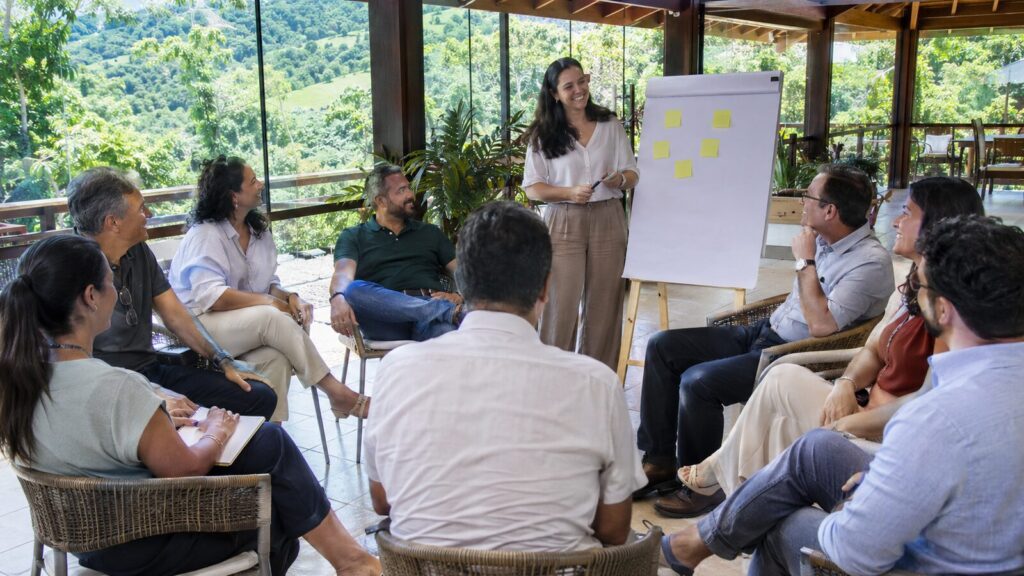
A common mistake is turning the offsite into a series of presentations. For the leadership to truly discuss and decide, the agenda needs time free of slides. A structure that tends to work:
- Opening with context: where the company stands, what has changed and what is expected from the meeting.
- 90-minute work sessions, each with a clear question and a defined deliverable.
- Real breaks, with time to walk and talk outside the room.
- A team moment at the end of the first day, such as a dinner, which helps open up difficult conversations.
- A close with decisions and owners: what was decided, who does what and by when.
Pre-reading sent a few days ahead keeps the meeting from spending hours bringing everyone up to speed.
Facilitation: who leads makes a difference
When the CEO or managing director leads every discussion, it is natural for people to be more cautious about disagreeing. A facilitator, internal or external, helps keep time, make sure everyone speaks and record the decisions. They also free the top leader to take part in the discussion as one more participant.
If the company chooses an external facilitator, involve them from the agenda design onward. They need to understand the business context and the goal of the meeting to lead it well.
Venue and logistics: what to consider
The ideal venue is far enough away to take people out of their routine yet easy enough to reach that the meeting is not spent on the road. For groups based in São Paulo, hotels in the countryside or on the coast a few hours’ drive away are often a good choice; when the leadership is spread across several cities, a destination with good air access works better.
- A main room with natural light, good acoustics and space to rearrange the tables.
- Breakout rooms for work in smaller groups.
- Privacy: a reserved space, away from other events and hotel guest traffic.
- Equipment: projector or screen, flip charts, stable internet and, if needed, a connection for remote participants.
- Light meals during the day, timed to match the agenda.
- Organized transportation: flights, airport transfers or an executive coach leaving from the company.
After the offsite: turn decisions into action
The value of a strategic offsite shows in the following weeks. Send the summary of decisions within two days, with owners and deadlines. Schedule a follow-up meeting in 30 days and define how and when the results will be shared with the teams. Without that follow-up, the meeting risks becoming just a good memory.
Strategic offsite with ArrowTur
ArrowTur handles all the logistics of your strategic offsite: we recommend and quote hotels and venues with suitable meeting rooms, arrange participants’ flights and transfers, manage rooms and confirmations and work alongside the facilitator and event suppliers. Our team supports the operation Monday to Friday, 7 a.m. to 7 p.m. (Brasília time), with emergency support outside those hours. Learn more about our corporate events services.
To talk to our sales team, call +55 11 5189-4120 or message us on WhatsApp.
Read also: Managers’ meeting: how to plan it from goal to logistics.
Frequently asked questions
How long should a strategic offsite last?
Usually one to three days. Two days with one night at the venue are generally enough to discuss in depth and still have a team moment.
How many people should take part?
Groups of 8 to 20 people work best for strategic discussions. Beyond that, it is worth splitting into working groups or considering another event format.
How far in advance should I plan?
Start two to three months ahead to secure the venue, dates in the leadership’s calendars and good airfares. In high season, plan even earlier.