Talk to our sales team
+55 11 5189-4120
Corporate travel
Field team travel: logistics without improvisation
How to organize travel for technical and field teams: job schedule, long-stay hotels, local transport, tools, expenses and safety, without improvising.
 5 min read
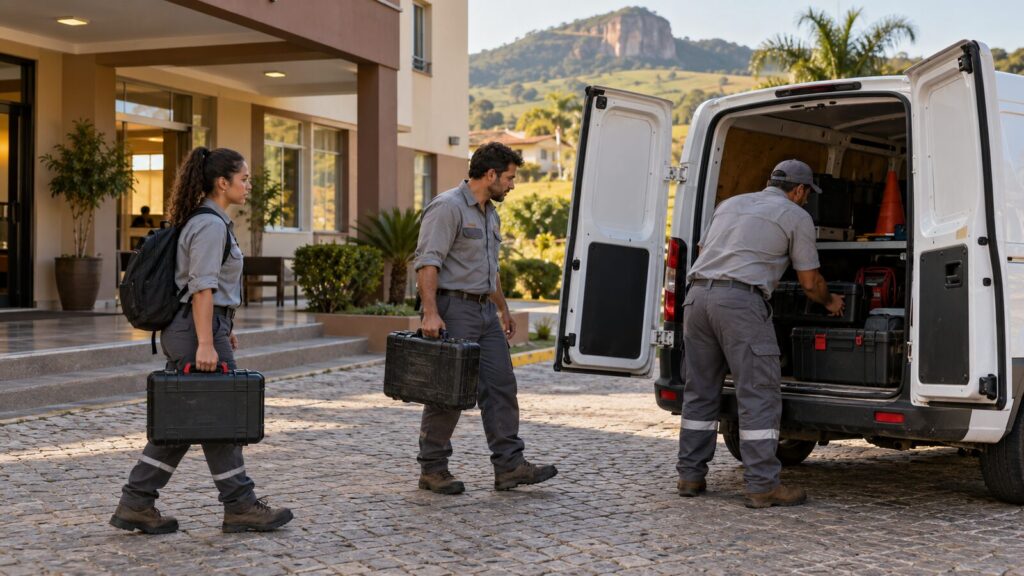
Maintenance, installation, construction, audit and technical support teams travel differently from an executive heading to a meeting. They travel in groups, carry tools and equipment, stay for weeks in the same place and often work in small towns far from airports. When travel for technical and field teams is organized at the last minute, the cost shows up as idle hours, expensive last-minute hotels and tired people on site.
At ArrowTur, which has organized corporate travel since 1989, we serve companies with field teams across several Brazilian states. Experience shows that most problems can be avoided with planning and a few clear rules. Here is how to structure this logistics.
What makes field travel different
A technical team’s trip has features that a standard travel policy does not always cover:
- Destinations outside major cities: the flight is only part of the journey; there are often hours of driving to the work site.
- Groups that move together: one person’s delay affects everyone.
- Long stays: weeks or months in the same town, with crew rotations.
- Changing dates: the end of the job depends on the project, a part that has to arrive or the client’s sign-off.
- Heavy luggage: tools, measuring instruments and protective equipment.
Recognizing these differences is the first step toward specific rules, instead of treating every trip as an exception.
Planning: start from the job schedule
Logistics should start from the project schedule, not from the day someone remembers to request a ticket. As soon as the mobilization is confirmed, send the travel team the names of the crew, the planned departure and return dates, the work site address and the start time on the first day.
This makes it possible to choose the most convenient airport, which is not always the one closest to the site, arrange ground transport to the final destination and book in advance, when fares tend to be better. For jobs with an uncertain end date, plan for return tickets with more flexible change rules.
Accommodation for long stays
For stays lasting weeks, the choice of hotel has a bigger impact on cost and on the team’s well-being. Some practical criteria:
- Distance from the work site: less commuting means more productive hours and less fatigue.
- Long-stay rates: many hotels offer special conditions for long stays or groups; negotiate before booking.
- Facilities: laundry, early breakfast, parking for the team vehicle and space to store equipment.
- Alternatives: in some cities, serviced apartments work better for very long stays.
In small towns, supply is limited and can sell out during trade fairs, harvest season or large construction projects. Booking early matters even more in these cases.
Local transport, tools and luggage
Decide before the trip how the team will get around at the destination: rental car, van, client vehicle or transfer. For groups, a rented van can be cheaper and more practical than several cars. Confirm who will drive, the vehicle category and the insurance coverage.
Tools and equipment deserve special attention. Sharp objects and many tools are not allowed in carry-on luggage, and batteries and some instruments have their own rules. Check the airline’s rules before departure and, when the volume is large, consider shipping the material by freight carrier or buying extra baggage allowance when the ticket is issued, which is usually cheaper than at the airport.
Per diems, expenses and reporting
Field teams usually have recurring expenses for meals, fuel, tolls and laundry. Define in the policy how these expenses are covered: a fixed per diem, reimbursement against receipts or a corporate card. On long stays, a clear rule avoids disputes and delays in expense reporting.
It is also worth planning for common situations: extending the job, returning early due to illness, swapping a crew member mid-project and trips home on rest days during very long stays.
Safety and tracking
Companies are responsible for the well-being of people traveling on business. For field teams, this means knowing where each person is, keeping emergency contacts up to date, understanding the risks of the region and making sure support is available when a flight is canceled or a road is closed. Centralizing bookings in a single channel makes this easier, because the company has everyone’s itinerary in one place.
Field team travel with ArrowTur
ArrowTur handles the full logistics of teams in the field: flights and bus tickets, hotels with long-stay rates, cars and vans, changes when the schedule shifts and reports by project and cost center. Our team is available Monday to Friday, 7 a.m. to 7 p.m. (Brasília time), with an emergency on-call service outside these hours to deal with issues such as canceled flights. Learn more about our corporate travel management.
To talk to our sales team, call +55 11 5189-4120, message us on WhatsApp or visit our Contact us page.
Read also: How to choose a business travel hotel.
Frequently asked questions
How far in advance should I request field team travel?
As soon as the mobilization is confirmed. The earlier you book, the more flights and hotels are available, especially in small towns.
Is renting a van better than renting cars?
For larger groups traveling together to the same site, a van is usually more practical and economical. For teams that split up across different fronts, cars may make more sense.
How do I handle uncertain return dates?
Choose fares with more flexible change rules for the return and agree with your agency on a quick process to adjust flights and hotels when the job ends earlier or later than planned.