Talk to our sales team
+55 11 5189-4120
Corporate travel
Business travel during holidays and peak season: how to plan
Holidays and peak season push up flight and hotel prices. Learn how to plan business travel in these periods with early booking, clear rules and lower costs.
 5 min read
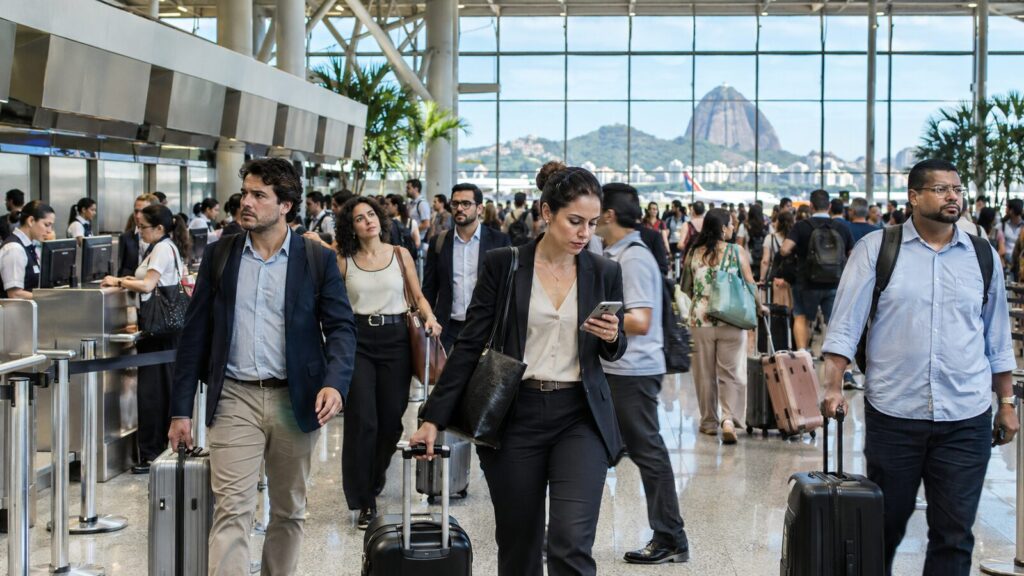
Carnival, the July school holidays, the year-end season and long holiday weekends completely change the picture for business travel in Brazil. Flights fill up, hotel rates climb, airports get crowded and there is less room for the unexpected. Anyone who has to travel on those dates, or just before or after them, feels it in both the budget and the schedule.
The good news is that most of this impact can be anticipated. At ArrowTur, which has been managing corporate travel since 1989, we see that the companies that get through peak season well are the ones that look at the calendar early and agree on simple rules with travelers and managers. Here is a practical guide to planning business travel during holidays and high-demand periods.
Know the peak periods that affect your company
Peak season is not just December and January. For business travel, it pays to map every period when demand for flights and hotels rises:
- Long holiday weekends: when a holiday falls next to a weekend, demand for flights on the eve and on the return day jumps.
- Carnival: cities such as Salvador, Recife, Rio de Janeiro and Florianópolis become expensive and crowded; in others, shops and offices shut down.
- School holidays: July and the December-to-February period raise occupancy in tourist destinations and on flights leaving the state capitals.
- Major events and trade shows: a big trade show, conference or concert can sell out the hotels of an entire area, even outside the holidays.
- Local dates: state and city holidays at the destination may close the very client the traveler is going to visit.
Cross-checking this map with the company’s sales and operations calendar already shows where the year’s risks are.
Booking ahead: the main tool in peak periods
On peak dates, the cheapest fares on each flight go first and well-located hotels fill up early. That is why the advance booking your travel policy requires on a normal day is often not enough. A few practices help:
- Identify trips already planned for holidays and vacation periods and book them as soon as the schedule is confirmed.
- For events, conventions and recurring visits, reserve hotels with a flexible rate at the start of planning, even before every name is defined.
- Do not leave return trips to the last week; they are usually the most sought-after seats around holidays.
When the date may still change, a slightly higher fare with easier changes can end up cheaper than losing the ticket or paying a steep fee later.
Shift dates and times whenever the schedule allows
Not every meeting needs to happen on the eve of a holiday. One day can make a real difference in price and comfort:
- Avoid flying on the late afternoon before a holiday or on the last day before everyone returns.
- Consider early-morning flights or less popular times.
- If the meeting is flexible, think about moving the trip to the week before or after.
- Check that the client or supplier will be open on that date: traveling to find a closed office is the easiest cost to avoid.
Hotels and ground transport in crowded cities
In peak season, your usual hotel may be sold out or priced well above the agreed rate. Keep nearby alternatives already vetted, and confirm whether the company’s negotiated rate applies on those dates, since many agreements have blackout periods.
Ground transport also deserves attention. On holidays, traffic to airports increases, check-in and security lines get longer and rental cars may run out. Ask travelers to arrive at the airport earlier, book transfers or cars in advance and build extra time into their schedule.
Clear rules in the travel policy
The travel policy is the right place to deal with these periods instead of deciding case by case. Some points that usually work:
- Longer advance booking for trips on known holidays and vacation periods.
- Adjusted fare caps for peak dates, so approvals do not stall because of a limit that only makes sense off-season.
- Criteria for traveling on a holiday: when it is necessary, who approves it and how the employee is compensated, in line with the company’s labor rules.
- Guidance on extending the stay privately over the holiday, with a clear split between what the company pays and what is personal.
Support and emergencies outside business hours
Holidays are when disruptions hurt the most: a cancelled flight in a packed airport, a hotel without the booked room, a meeting moved at the last minute. Travelers need to know who to call when the company office is closed. Make sure they have the support contacts, the booking references and basic instructions before departure.
Holiday business travel with ArrowTur
ArrowTur helps your company get through peak periods with lower costs and fewer surprises: we review the calendar of planned trips, book flights and hotels early, look for alternative dates and times, apply your travel policy and negotiated rates and support travelers during the trip. Our team works Monday to Friday, 7 a.m. to 7 p.m. (Brasília time), with an emergency service outside those hours, holidays included.
Learn more about our corporate travel service or contact us. To talk to our sales team, call +55 11 5189-4120 or message us on WhatsApp.
Read also: When to book business flights: an advance booking guide.
Frequently asked questions
How far ahead should we book flights for travel over holidays?
Ideally, as soon as the trip is confirmed. On long weekends and vacation periods, the cheapest fares and the most popular times usually sell out earlier than on regular dates.
Is a flexible fare worth the extra cost in peak season?
When the schedule may still change, usually yes. Changing a restricted fare on a peak date can cost more than the difference paid for a fare with easier changes.
Does the negotiated hotel rate apply on holidays?
It depends on the agreement. Many contracts have blackout dates for big events and holidays, so confirm early and keep nearby options ready.